
ERP Transformation for the Next Decade: A Boardroom Perspective — Why Moving from ECC to RISE with SAP Should Be a Business Transformation, Not Just a Technical Upgrade to Drive Competitive Advantage and Sustainable Growth.
As Indian manufacturing enterprises prepare for the transition from SAP ECC to SAP S/4HANA (On Premise or under RISE) due to EOL for SAP ECC platform by 2027, many boards view the decision primarily through the lens of technology obsolescence, vendor roadmap timelines, and infrastructure modernization.
But the real question before leadership and decision makers is larger:
Is this simply a software upgrade, or are we fundamentally reshaping our business for the years ahead?
As the majority of organisations are now evaluating S/4HANA on RISE, it is essential to recognise that this offering is not merely an updated version of SAP. Rather, S/4HANA on RISE signifies a transition toward:
- platform-driven operations
- intelligent data-driven decisions
- standardization with global best practices
- cloud-led scalability and lifecycle discipline
The organizations that will extract value from S/4HANA are those that treat this journey as a business transformation with strong governance rather than just a version migration.
A Critical Risk for Boards: Reproducing Legacy ECC Functionality in S/4HANA
Through our consulting and advisory work with numerous Indian enterprises on migration strategies, we've consistently noticed some common trends:
- ECC processes are lifted and shifted.
- Historical customizations are carried forward.
- Process variations across plants are preserved
- Excel-based workarounds silently continue
- Master data ownership remains unclear
- Implementation partners focus on migration speed and not on its value
As a result, even with a world-class S/4HANA platform, organizations continue to operate with legacy ECC practices. While the costs may be justified, the true business value often falls short.
In many cases where IDENHIVE has been brought in, we've helped board and decision-makers realize that the key question isn't:
"When should we move to RISE?"
but rather:
"How can we ensure S/4HANA becomes a strategic operational platform, not just another technical upgrade?"
And the answer lies in fostering strong governance, clear leadership ownership, and an effective transformation architecture.
RISE with SAP sees technology as the driving force, while governance provides lasting value.
S/4HANA and RISE bring powerful advantages:
- Cloud lifecycle management and ongoing innovation
- Streamlined data models with real-time analytics
- Built-in controls and standardised processes
- Unified planning across finance, logistics, and manufacturing
- Enhanced audit readiness and compliance
- Scalability for future digital projects
But these benefits materialize only when the transition is guided by a board-endorsed transformation agenda rather than project delivery milestones.
The mindset shift is fundamental which can be understood from below:
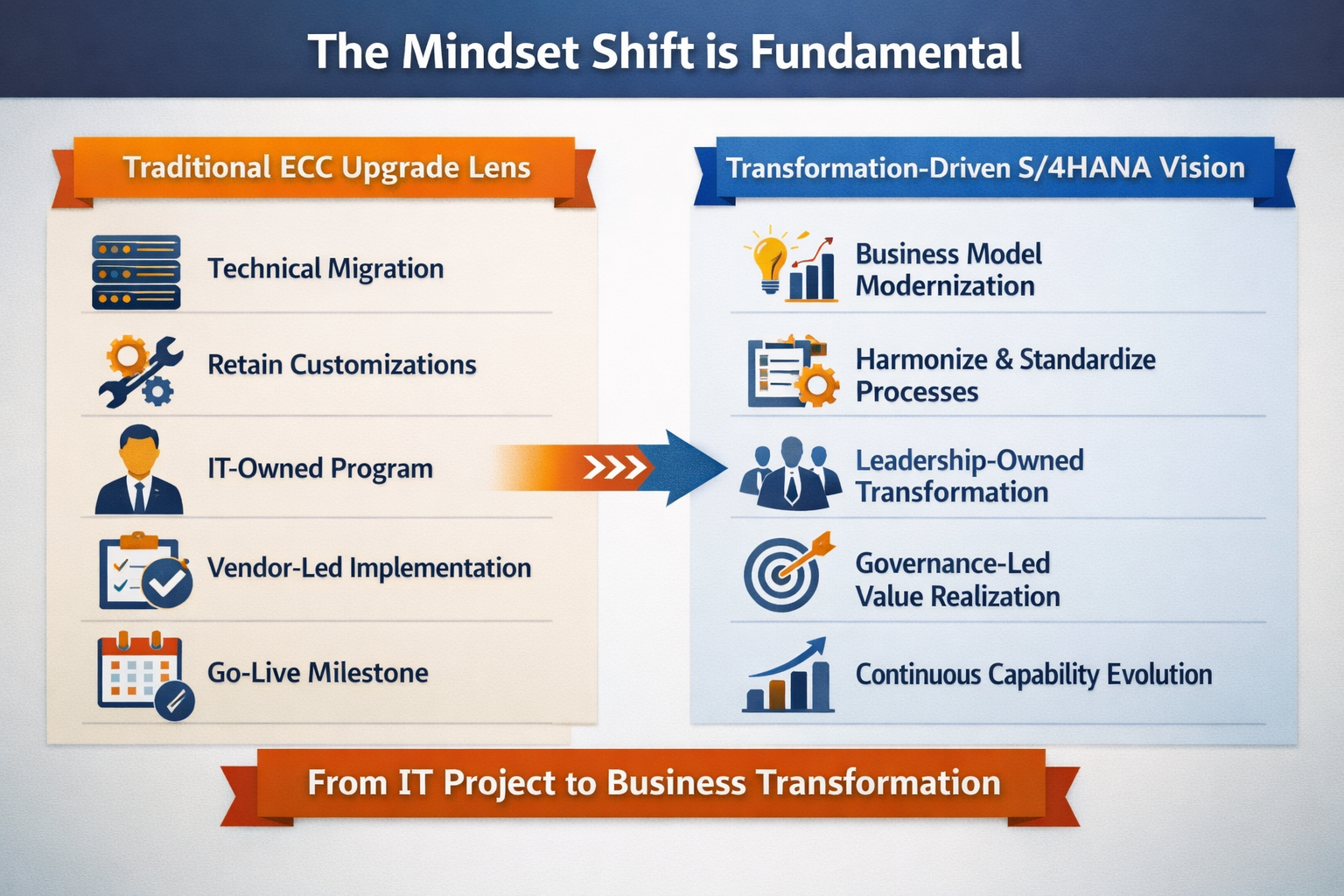
S/4HANA under RISE serves as a foundational platform; effective governance transforms it into a strategic asset.
A Real-World Indian Manufacturing Case Study: When Governance Changed the Outcome
A mid-sized, multi-plant manufacturing group in India previously implemented ERP solutions but encountered several challenges, including:
- fragmented inventory visibility
- plant-wise process deviations
- spreadsheet-driven planning
- inconsistent master data
- delayed financial closure
- weak adoption discipline
When the board initiated the transition to S/4HANA under RISE, the focus deliberately shifted from "How quickly can we migrate?" to "How can we fundamentally redesign our enterprise operations?" The organization adopted a structured, board-led transformation approach as follows:
1. Formation of a Transformation Steering Committee: Chaired by the Group CEO with participation from the CFO, Operations Head, CHRO, and CIO.
2. Redefinition of Project Objectives: Centered on working capital optimization, productivity enhancement, cycle-time reduction, control assurance, and real-time business visibility.
3. Process Harmonization: Standardization replaced local variations across Procure-to-Pay, Plan-to-Produce, and Order-to-Cash processes.
4. Establishment of an ERP Center of Excellence (CoE): Focused on master data governance, analytics enablement, release and change control, and capability building.
5. Assignment of Adoption Accountability: Shifted responsibility for system adoption to business leadership.
This comprehensive approach enabled the organization to standardize processes and realize significant business outcomes within 12–18 months:
- Inventory turns improved by approximately 18–22%
- Procure-to-pay cycle times were substantially reduced
- Month-end close times decreased from over 10 days to about 4–5 days
- Audit findings were minimized through embedded controls
- Management dashboards replaced manual reporting
During one of the client engagement while we restructured the governance for a manufacturing client, a board-led transformation approach didn't just accelerate deployment timelines, it fundamentally restructured the organization's operating discipline through:
Post go-live, the organization's standardized financial close time improved by 40%, and the company is now using S/4HANA's embedded analytics for monthly board reviews not as a system attribute to a business asset in true sense.
This case highlights that S/4HANA's technical capability gains strategic significance through a governance-led adoption. Business differentiation does not stem from technology itself, but rather from the manner of implementation and continued utilisation.
Also, the change governance is essential for evolving behaviours rather than merely introducing new screens.
RISE with SAP : What the Board Should Deliberate On
As organisations evaluate digital transformation options like RISE with SAP, it is crucial for board members to focus on strategic considerations rather than operational details. The decision should not be limited to:
- Licensing models
- Infrastructure hosting
- Hyperscaler choices
- Migration sequencing
Those are operational decisions. However, for effective governance and long-term value creation, the board should prioritise deliberation on the following strategic levers:
At the board level, the following strategic levers are critical:
1. Should we harmonize processes or maintain legacy variations?
Customization should be preserved solely when it enables business differentiation, rather than for reasons of historical familiarity.
2. Who is responsible for data quality, is it IT or business leadership?
The analytical capabilities of S/4HANA rely on
- Master data discipline
- Governance workflows
- Accountability metrics
It is imperative to transition data perception from a system attribute to a business asset.
3. Are we actively investing in change adoption, or merely assuming users will adapt?
The organizational context within Indian enterprises necessitates:
- Narrative-driven communication
- Role-based capability building
- Leadership alignment across plant and functional levels
While technology modernizes tools, change governance is essential for evolving behaviours
4. Do we possess a value-realization framework, or simply a project plan?
Boards must monitor.
- Working capital impact
- Cycle-time reduction
- Reporting velocity
- Process control maturity
- Productivity outcomes
ERP transformation should be governed with the same rigor as business strategy execution, rather than being treated solely as a system implementation.
A Pragmatic Transformation Blueprint for ECC to S/4HANA (RISE)
1. Reassess the business case and strategic objectives
2. Define the target operating model and governance framework
3. Standardize key processes prior to platform migration
4. Establish an ERP Center of Excellence at the outset of the program
5. Enforce robust data governance and master data ownership practices
6. Prioritize analytics enablement alongside transactional migration
7. Implement a continuous improvement strategy following go-live
This approach guarantees that the transition to RISE is prepared for the future, led by the business and focused on delivering value rather than merely achieving a technically successful yet strategically limited upgrade.
Final Recommendation to the Board
Transitioning from ECC to S/4HANA through RISE isn't just about dealing with product end-of-life or updating infrastructure. It's a chance to:
- standardize organizational processes
- enhance governance and controls
- enable better data-driven decisions
- embed operational discipline
- build a flexible digital foundation for the future
Rather than asking "Should we move to S/4HANA?", the real consideration is whether we'll see this as a simple system upgrade or a genuine transformation of how our enterprise operates, makes decisions, and grows. While technology speeds up modernization, effective governance turns it into enduring value for the organization.
By IDENHIVE Team