
Cloud Governance: Balancing Innovation and Control
Cloud has become the default platform for modernization across Indian enterprises, from manufacturing and BFSI to startups and public sector organizations. But as teams adopt cloud rapidly, many organizations discover the flip side: rising costs, fragmented security controls, compliance risks, and inconsistent architecture decisions.
Traditional governance models are built around heavy approvals, rigid architecture standards, and central gatekeeping which results in slow innovation and push teams to bypass controls. On the other hand, a "free-for-all cloud" leads to sprawl, security exposures, and budget surprises.
Effective cloud governance is not about restriction. It is about enabling innovation within guardrails where teams can experiment rapidly while security, cost, and compliance remain predictable and auditable.
Below is a pragmatic approach Indian organizations can adopt, grounded in real-world enterprise experience.
Shift from Control to Enablement
Governance must evolve from:
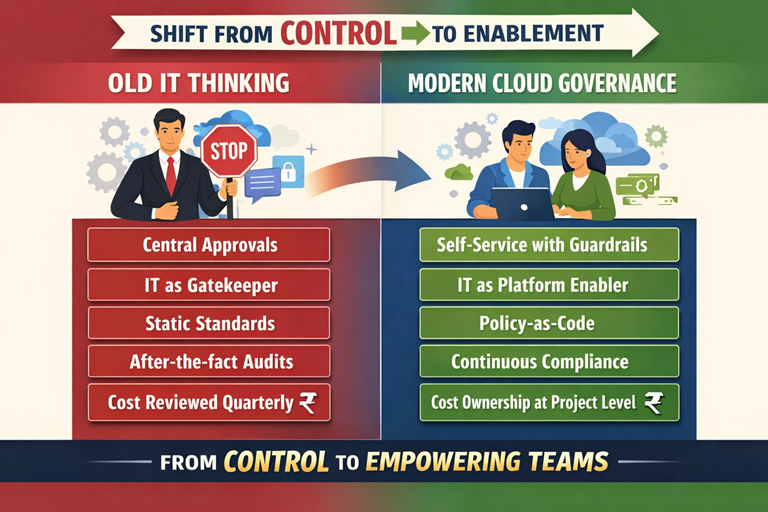
The goal is to bake governance into the operating model, not treat it as a policing function.
Start with a Cloud Operating Model
Before introducing tools and policies, define who does what.
A simple, effective structure for Indian enterprises should be as follows:
1. Cloud Center of Excellence (CCoE) to own the enablement function and responsible for:
- platform engineering
- landing zone & baseline security
- architecture standards
- reusable templates
- training & community of practice
Think of CCoE as a cloud product team, not a committee.
2. Business & Application Teams as custodian of innovation and:
- own workloads and budgets
- choose suitable services within guardrails
- are accountable for performance, security, and availability
Cloud success happens when ownership shifts to application teams, not only IT.
3. IT Security, Risk & Compliance teams to define and ensure:
- minimum security standards
- regulatory requirements (RBI, IRDAI, SEBI, CERT-In)
- logging & incident response expectations
Instead of reviewing deployments manually, they collaborate to codify controls.
Implement Guardrails, Not Gatekeeping
Guardrails allow innovation without chaos.
Platform-level Guardrails (Always-On Controls)
These should be enabled centrally in the landing zone:
- Mandatory encryption at rest & transit
- Role-based access control (no shared admin accounts)
- Centralized logging & SIEM integration
- Network segmentation & private connectivity
- Geo-location control for India data residency
- Default backup and retention policies
- Tagging standards (owner, cost-center, environment)
These are non-negotiable controls, but automated and not manually enforced.
Adopt Policy-as-Code Instead of PDFs & Checklists
Instead of reviewing architecture decks, implement automated policies:
- Azure Policy
- AWS Control Tower / Service Control Policies
- Google Organization Policies
- Terraform Sentinel / Open Policy Agent
Examples:
- Block public S3 buckets
- Disallow privileged IAM roles
- Enforce India region usage unless exception approved
- Require encryption on databases
This reduces friction and improves compliance without slowing developers.
Make Cost Governance a Daily Habit
Many Indian organizations move to cloud expecting savings and then face bill shocks.
The issues typically arise from:
- unused environments
- oversized compute
- zombie storage
- unmanaged experiments
- lack of ownership
Cost governance must be proactive and transparent.
Practical Measures
- Create budgets per project / business unit
- Enable chargeback or showback
- Set lifecycle policies for non-prod environments
- Use auto-shutdown schedules
- Right-size based on usage patterns
- Review reserved instances / savings plans
- Track ROI for cloud workloads
A simple but powerful practice: Every cloud project must have a cost owner.
Finance, business, and IT should review cloud spend monthly, just like utilities.
Enable Innovation Sandboxes - With Limits
Teams need room to explore new services and prototypes.
Create innovation sandboxes with:
- predefined spending limits
- restricted outbound access
- automated cleanup schedules (30/60/90 days)
- sample templates & baseline controls
- separate billing visibility
This allows experimentation without affecting production or compliance.
Balance Cloud-Native and Legacy Reality
Many Indian organizations operate hybrid environments:
- Core ERP on-premise or hosted DC
- Analytics, mobility, and modernization workloads on cloud
Governance should recognize that:
- Not every workload belongs in cloud
- Migration should be value-driven, not lift-and-shift
- Architecture choices must align with business outcomes
Avoid rigid cloud-only mandates. Focus on right workload, right platform.
Embed Security into the Lifecycle
Security should shift left and not bolt-on at the end.
Practical security practices:
- Threat modeling for critical workloads
- CI/CD integrated security scans
- Managed secrets & key vaults
- Zero-trust access for admins
- Regular disaster-recovery drills
- Insider threat monitoring
- CERT-In breach reporting readiness
For regulated industries, maintain:
- audit trails
- data classification registry
- vendor cloud risk due-diligence
Cloud governance is effective when security teams feel confident, and developers feel empowered.
Invest in People, Not Just Platforms
Cloud governance fails when skills lag behind ambition.
Indian enterprises should:
- build full-stack cloud engineering talent
- cross-skill infrastructure teams
- train developers on FinOps & security basics
- create peer learning forums
- encourage certifications, but focus on hands-on adoption
The best governance cultures treat cloud as a capability, not a procurement contract.
A Practical Rollout Roadmap (12–18 Months)
Phase 1 — Stabilize
- Establish CCoE
- Build landing zone & guardrails
- Define cost ownership model
Phase 2 — Standardize
- Adopt policy-as-code
- Enable observability & cost dashboards
- Introduce sandbox environments
Phase 3 — Scale
- Automate provisioning via templates
- Introduce continuous compliance
- Expand DevSecOps & FinOps practices
Governance must evolve incrementally and not as a big-bang program.
Closing Thought
Cloud governance is not about stopping teams from innovating — it is about making innovation safe, scalable, and financially disciplined.
Organizations that succeed treat governance as:
- an enabler, not a barrier
- a shared responsibility model
- a culture of accountability and transparency
With the right guardrails, Indian enterprises can accelerate cloud-led transformation — while staying secure, compliant, and cost-effective.

By IDENHIVE Team